For next week we our readings are all about collaboration.
The first reading is a return to Pablo Helguera's Education for Socially Engaged Art, where we will read 2 chapters: Community & Collaboration. The pdf includes the whole book so just sift through to read those two chapters.
The second is a group conversation/interview between artists and art organizers who have a lot of experience working collaboratively in different ways.
Looking forward to talking about these with you all.
Saturday, November 4, 2017

Friday, November 3, 2017
Readings Week 7 (Michael)
Pablo
Shannon Jackson compares and contrasts SEA projects in her study Socia Works: Performing Art, Supporting Publics, Juxtaposing the community art project Touchable Stories (Begun 1996), by Shannon Flattery, Which seeks to help “individual communities define their own voice,” the artist says, and the work of Santiago Sierra, who pays workers from disadvantaged and marginalized groups to do demeaning tasks.*
* Shannon Jackson, Social Works: Performing Art, Supporting Publics (London: Routledge, 2011), p. 43.
+THIS is not meant to be a critique of community art, which, like all forms of art, exists in more and less successful iterations. Not is it a critique of Sierra’s practice. The examples are presented merely to illustrate the spectrum along which collaboration and confrontation operate.
-
This points to larger unresolved issue: Does SEA, by definition, have particular goals when it comes to engaging a community?
-
Many problems in community projects are due to unrealistic goals in relation to the expected time investment. A SEA project can make particularly great demands of time and effort on th artist--demands that are usually at odds with the time constraints posed by biennials and other international art events , let alone the pressure for product and near-immediate gratification from the art market.
Pg 63 (continued from statement on 62)
Ashford: “In 1983, Raymond Bonner and Susan Meiselas got the art world to acknowledge tat El Salvador was ucked up. At the New York Times, they made a leap from journalistic practice to changing foreign policy. Professional lives like this that are truly non- or cross-disciplinary rarely exist anymore.”
Question: Like the fate of the downfall of investigative journalism within the larger culture of news media, is the practice of Socially Engaged Art suffering at the behest of art institutions?
Felshin: For the most part, I don’t believe that artists think they need to be careful, but my own experience is that when I propose a political exhibition at Wesleyan, it is looked at carefully in advance And sometimes the programs that accompany it are scrutinized and criticized. Universities are being very careful these days And I think that some of this has to do with corporate influence and funding.
Ewald: People are scared to lose their funders, so self-censorship comes in. Even if they're working outside of the art practice, Most everyone wants to be part of the art word There’s a flowering of people working with kids in photography, and where are those photographs sold? Sotheby’s, for example.
Felshin: During the late- 1980’s recession, it didn’t look good for corporations to buy artwork, so they started funding education projects, and this was true in the 1990’s as well. Funding priorities can drive what happens, what is produced, the programs that are initiated. ‘If you do this, w’ll pay for it.’ And it’s better for their image to fund things that involve the community.
Question: Recently during discourse about my work many professed the nature of it all being both confusing and problematic. That said, is not the nature of how art is being funded and where it's being exhibited and to whom often if not almost always problematic in some way? Is it not inherent in art, SEA especially, that there will be some aspect that's considered problematic?
Ashford: My dear friend Steve Kurtz has written about the Web and the growing activist amateurism. The international response to his arrest is an example of its collaborative capacity. His arrest may be a sign of how threatening the idea of artist as a reprofessionalized, activist amature may be.
Question: Given the possibility for SEA to be hyper politicized, is the nature of this work being censored and sabotaged before it can truly grow into its most powerful manifestation? Is this work being censored and muddled with by artists, creators, collaborators, and art institutions by both trying to frame the nature of it, and by subjecting it to critique and standards pre established by methods of art making that indirectly gave way to SEA but are ultimately inherently different?
Wednesday, November 1, 2017
Artistic Placement Group
The Artistic Placement Group (AGP) was established 1966 in London. The idea of the group was conceived by Barbara Steveni and her husband John Latham in 1965 along with other notable members, Barry Flanagan, David Hall, Jeffrey Shaw, Stuart Brisley, Hugh Davies,Andrew Dipper, David Toop and Ian Breakwell.
The APG concept was driven by “dematerialisation”, moving away from object-based work as a means of understanding the meaning of the piece. The sought to take art out of the studios and into the institutions of society focusing towards site-specific work and to build social relationships. Starting in Europe they expanded to Germany, Austria, France and the Netherlands

The APG was initially constituted as a charity with a board of artistic directors, and later converted into a limited company. Steveni remained a key driving force being creating contacts, maintaining correspondence with hundreds of companies and organisations.
Their mission statement was that “Art would no longer be confined to the studio and galleries, the their field of activity would be extended to the commercial, industrial and administrative contests to act up societal organisations and decision making process.”

The AGP actively sought to have “placements” in industry or public institutions making the case that an artistic presence out be a mutual benefit between the organisations, considering themselves a placement agency. Without explicit membership, it was comprised of a loose network of artists who would be proposed to organizations willing to participate. Ideally, each placement would work for several months under a ‘feasibility study’. The central premise of the negotiations was to guarantee the principle of open-ended work during placements. The artist would function as an independent observer within the organization
During this time the artist would familiarize one’s self with the work place to consider what specific context could formulate and artistic proposal, whatever the case may be, in hopes for longer placement on the various projects. It often did not progress beyond the feasibility study.
Representatives for business and government were invited to APG’s studio to discuss their project proposals. Their public presentations tended to not go over well with most of the organisations that they were employed by due to their performative nature.

After 1989 the AGP developed into Organisation and Imagination (O+I).
Following that, in 2004 the Tate gallery in London purchased the APG archives.
http://en.contextishalfthework.net/about-apg/artist-placement-group/
British Steel Corporation 1969-1971

Department of the Environment, Inner Areas Study Birmingham, 1975
Roger Coward with Gavin Brown, Roland Lewis, Evadne Stevens, Frances Viner
Roger Coward with Gavin Brown, Roland Lewis, Evadne Stevens, Frances Viner

Department of Health and Social Security (1976)
Feasibility Study: Hugh Davies and Ian Breakwell
Placement: Ian Breakwell
Feasibility Study: Hugh Davies and Ian Breakwell
Placement: Ian Breakwell

Link to the archive:
http://en.contextishalfthework.net/exhibition-archive/exhibition-concept/
Relational Aesthetics, Relational Art, RA
Relational Aesthetics, Relational Art, RA (1998/2002)


Postproduction (2001)
In Postproduction, I try to show that artists' intuitive relationship with art history is now going beyond what we call "the art of appropriation," which naturally infers an ideology of ownership, and moving toward a culture of the use of forms, a culture of constant activity of signs based on a collective ideal: sharing.
Then I was like ENOUGH WORDS ABOUT STUFF!
Artists:
Rirkrit Tiravanija
According to art historian Rochelle Steiner, Tiravanija's work “is fundamentally about bringing people together.”

Matthieu Laurette
"USING SOCIETY AS A CATALOG OF FORMS When Matthieu Laurette is reimbursed for products he has consumed by systematically using promotional coupons ("Satisfaction guaranteed or your money back"), he operates within the cracks of the promotional system. When he produces the pilot for a game show on the principle of exchange (El Gran trueque, 2000) or establishes an offshore bank with the aid of funds from donation boxes placed at the entrance of art centers (Laurette Bank Unlimited, 1999), he plays with economic forms as if they were the lines and colors of a painting."
- Bourriaud in Postproduction
- Bourriaud in Postproduction

Vanessa Beecoft
An Italian contemporary performance artist. She works in the United States. Many of her works have made use of professional models, sometimes in large numbers and sometimes naked or nearly so, to stage tableaux vivants.

Santiago Sierra
"The work of Santiago Sierra (born in 1966), like that of Tiravanija, involves the literal setting-up of relations among people: the artist, the participants in his work, and the audience. But since the late 1990s Sierra’s “actions” have been organized around relations that are more complicated—and more controversial—than those produced by the artists associated with relational aesthetics."
- Claire Bishop in Antagonism and Relational Aesthetics
www.santiago-sierra.com/


"The work of Santiago Sierra (born in 1966), like that of Tiravanija, involves the literal setting-up of relations among people: the artist, the participants in his work, and the audience. But since the late 1990s Sierra’s “actions” have been organized around relations that are more complicated—and more controversial—than those produced by the artists associated with relational aesthetics."
- Claire Bishop in Antagonism and Relational Aesthetics
www.santiago-sierra.com/


Pierre Huyghe
Maurizio Cattelan
Gabriel
Orozco
http://www.artnet.com/artists/gabriel-orozco/
http://www.artnet.com/artists/gabriel-orozco/
Dominique Gonzalez-Foerster
http://www.dgf5.com/
http://www.dgf5.com/
Liam Gillick
Excavating the Art of Alfred
Sarah Britten-Jones
Artist Statement
I source conceptual and physical material from my environment or situation, and manipulate it to reveal truths that are often denied or hidden. I am interested in the stories we tell ourselves in order to live, and how these self-narratives are exercised and take form through the things we create and consume. My work often provides an antithesis to the dominant storyline.
http://www.sarahbj.com/


Me presenting Zach

Additional sources not cited above:
Niccolas Bourriaud: https://en.wikipedia.org/wiki/Nicolas_Bourriaud
Relational Art: https://en.wikipedia.org/wiki/Relational_art
Relational Aesthetics: https://drive.google.com/file/d/0B00prLgUe9lWWFFIQjh5RXpoVkk/view
Postproduction: http://faculty.georgetown.edu/irvinem/theory/Bourriaud-Postproduction2.pdf
Claire Bishop - Antagonism and Relational Aesthetics: http://www.teamgal.com/production/1701/SS04October.pdf
Boris Groys: https://www.onlineopen.org/download.php?id=449
http://www.sarahbj.com/

ULTRA CONTEMPORARY!
Stephanie Giera

Elena Gross
Bedspace B By Zac Whitworth
Me presenting Zach

Zach's inspiration:
Awol Erizku: https://www.instagram.com/awolerizku/
In Closing
Postproduction last page
It is up to us as beholders of art to bring these relations to light. It is up to us to judge artworks in terms of the relations they produce in the specific contexts they inhabit. Because art is an activity that produces relationships to the world and in one form or another makes its relationships to space and time material.
Niccolas Bourriaud: https://en.wikipedia.org/wiki/Nicolas_Bourriaud
Relational Art: https://en.wikipedia.org/wiki/Relational_art
Relational Aesthetics: https://drive.google.com/file/d/0B00prLgUe9lWWFFIQjh5RXpoVkk/view
Postproduction: http://faculty.georgetown.edu/irvinem/theory/Bourriaud-Postproduction2.pdf
Claire Bishop - Antagonism and Relational Aesthetics: http://www.teamgal.com/production/1701/SS04October.pdf
Boris Groys: https://www.onlineopen.org/download.php?id=449
Site-Specific
Some properties that may apply to a site-specific work:
Physically accessible, different curatorial practices, dimension of
documentation as part of work, not commodifiable in capitalist art market, (can
be) temporal, interplay with site, can address the site’s history and cultural
value when threatened, shifting meaning from art object itself to context and
interplay between object(s) and site.





“If modernist
sculpture absorbed its pedestal/base to sever its connection to or express its
indifference to the site, rendering itself more autonomous and self-referential,
and thus transportable, placeless, and nomadic, then site-specific works, as they first
emerged in the wake of Minimalism in the late 1960s and early 1970s, forced
a dramatic reversal of this modernist paradigm.” –Miwon Kwon
Gordon Matta-Clark and Creative destruction
“The notion of “anti- or non-architecture” was based on the
use of space as a conceptual element, not only from an architectural dimension,
but also in relation to social space.
The intention was to take advantage of the holes, empty space, and unused
places …”
-Lola Hinojosa
“His best-known works of the ’70s, including abandoned
warehouses and empty suburban houses that he carved up with a power saw,
offered potent commentary on both the decay of the American city and the
growing sense that the American dream was evaporating. The fleeting and
temporal nature of that work — many projects were demolished weeks after
completion — only added to his cult status after an early death in 1978, from
cancer, at 35…how cleverly he challenged the high priests of architecture who,
in Matta-Clark’s mind, inhabited a world of lofty abstractions divorced from
the physical reality of everyday life. That critique is newly resonant, when
even the most radical architectural ideas are quickly gobbled up by the
cultural mainstream and take on the slickness of advertising slogans.”
-NYT
Splitting (1974) – Performance and video

This
house was located in Englewood, New Jersey, which was a suburb developed
during white flight from the urban core, and was experiencing depopulation
after the post-war downturn at the time of the work. With Matta-Clark’s work
there was an emphasis on physical process as performance, as the artist worked
with another laborer to create the fissure by jack-hammering away at the
foundation, removing a layer of bricks, and making a clean cut through the
middle.
“Matta-Clark understood the psychic power of buildings over
people. In one notebook from 1976, he wrote that he wanted to ‘convert a place
into a state of mind’. [8] This bond between home and occupant was articulated
in the correspondence that Matta-Clark received after Splitting was opened for
viewing. A number of letters complained about what he had done, saying that he
had violated the sanctity and dignity of abandoned buildings; one even likened
it to rape. [9]
Matta-Clark felt, like the Situationists, that this dream
had been used as a political tool by the ruling classes through the provision
of convenience and dwellings, in order to contain and control the masses.”
-The Ibtauris Blog
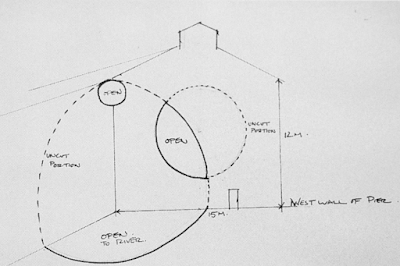
Day’s Passing/Day’s End (1975)


“During the summer of 1975, Matta-Clark made a series of
large cuts into a 600-ft long metal hangar on Pier 52 that had once belonged to
the Baltimore and Ohio Railroad Company. Removing sections of the floor and
ceiling, along with portions of the western and southern sides of the building,
the artist exposed the river and sky, creating a changing sculpture of light
out of a structure the city had largely abandoned.”
-Creativetime.org

“…(it was) a temporary cathedral of light. He even made a
moat inside, by removing a 10-foot-wide section of the wood floor. And with a
blowtorch he cut an enormous elliptical window out of the tin wall at the far
west end.
In the film…you see him suspended, his face brightly
reflected in the sparkly glare of the torch, cutting the ellipse, then slowly
removing it with a winch. Late afternoon sun pours around the edges, making a
kind of drawing out of blinding light. The effect resembles a lunar eclipse,
and it’s just plain magnificent.”
-NYT
The
idea was to reclaim a lost and abandoned part of deindustrialized New York City
for public enjoyment and creative expression. This was illegal and unpermitted!
Unfortunately it was immediately closed by the police, and was never open to
the public, as intended. Works like this become commodified through
documentation, for example, a 23 minute super 8 film about this work is in
MoMa’s collection.
Inigo Manglano-Ovalle - Le Baiser/The Kiss (1999)
“…is set in Mies's Farnsworth House and features a
large-scale double-sided video projection
that presents the artist as a window washer dressed in workman's jumpsuit,
carefully washing the house's large exterior windows and glass doors with a
squeegee. Inside the house, a woman stands at a DJ station spinning records,
conspicuously oblivious to the diligent window washer right outside the window.
In this work, Manglano-Ovalle pays homage to Mies's cool modernist space while
at the same time sets up a social dynamic that explores the nuances of class
structures and hierarchies.”
-Orange
County Museum of Art

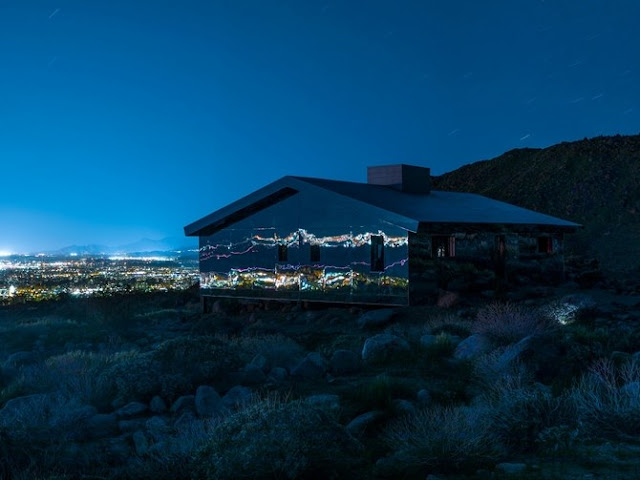
Doug Aitken, Mirage (mirror house) (2017)
This work is a commentary on urban sprawl and
encroachment on the last undeveloped parts of open land, using the Coachella
Valley in California as a setting. Not surprisingly, it also serves as the
ideal backdrop for Instagram and other social media. This work is interesting
to me because, though it was ostensibly created as a statement about
commodification and consumerism, it also functions as the perfect commodity
fetish object.

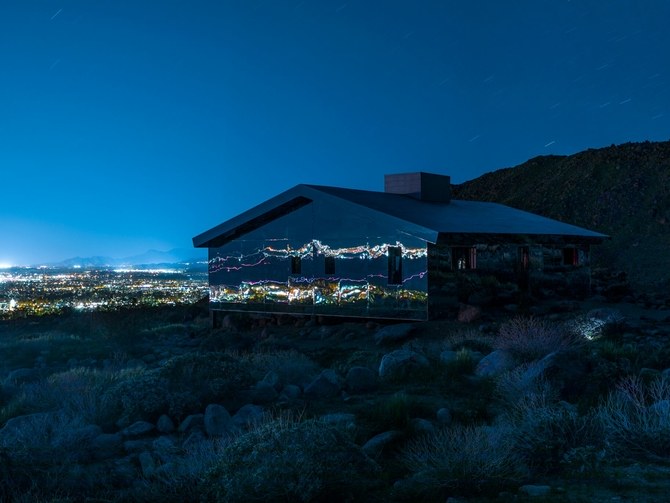
“In the tradition of land-art as a reflection of the dreams
and aspirations projected onto the America West, Mirage presents a continually
changing encounter in which subject and object, inside and outside are in
constant flux. The ranch-style structure suggests a latter-day architectural
version of manifest destiny, a primary structure rendered by the artist without
function service or texture.”
-DesertX Website
“Aitken describes “Mirage” as a study of the relationship
between the architecture of the typical suburban ranch house (and its
forebears, including residential designs by Frank Lloyd Wright and others) and
the natural landscape that it both relies upon and threatens to destroy. ‘I
knew for the work to function I need a location on a hillside where there’s a
view of urban sprawl…Where the sprawl ends and the desert begins. This is not
the kind of project where you can compromise and do it wherever.’”
-LA Times, Christopher Hawthorne
“’In a lot of ways,” he explains, “the inspiration for this
as a sculpture is the architecture you don’t remember. I was interested in what
you had driven by thousands of times and you don’t even register its presence
because it’s just so much a part of the pattern.’”
-Architectural Digest
Rachel Whiteread, Cabin (2015)
Whiteread’s work deals with architecture, space, absence and
memory. She often uses casting processes, with materials like plaster,
concrete, resin and rubber, to highlight the absence of the referenced original
structure or object.
She is a British artist, and Cabin is her first major US
commission – part of the Governors Island Park revitalization efforts in New
York. The work is intended to evoke the contemplative solitude of Thoreau, but
it could also be read as a retreat fitting for the Unibomber, with views of
both the Statue of Liberty and Ground Zero.


“’It is partly my mission to make things more complicated to
look at, more of an effort and more of an experience,” she continues. “You get
on a boat and go across the water. You’ll see the Staten Island ferry, see Lady
Liberty, get a little bus or walk across the island and then you’ll come across
Cabin. It’s not a quick thing and it’s to do with expectation. The whole thing
will take a few hours and will hopefully remain with you for a few hours. I
hope people try to get some sense of what I am trying to make happen. It’s a
slow burn.’”
-The Guardian
“But she said: ‘I’m not a great fan of what I call ‘plop
art’, where you plop a piece of work down where it doesn’t bear any
relationship to anything else. Art has got extremely popular, and for many reasons that’s great. But
I think a lot of public sculpture is ill thought out and put in places that it
shouldn’t necessarily be.It becomes something then that’s invisible. People
don’t even notice it. Art is there for a reason and should be respected and
looked at and not just a side show.’
-Belfast Telegraph
Chihara Shiota, Trace of Memory (2013)


The Mattress Factory, Pittsburgh, PA
“…while some
people try to cleanse spaces or their superstitious gateways by sageing
doorways, this installation does the opposite, appealing to some kind of
liminal god to crack open time, resurface the past, and let it linger in the
present...Shiota came up with stories by drawing from the building’s
many layers of wallpaper, while imagining the lives of the house’s former
occupants. Following the deindustrialization of the US and the resulting
economic collapse around 1980, 516 Sampsonia Way sat empty for years.’”
Jenny Holzer, Truisms/Messages to The Public (1982)
Messages to The Public
was a public art project that used the Spectacolor board in Times Square for a
changing sequence of artists from 1982-1998 to display words and images. Jenny
Holzer’s contribution, part of her Truisms series, is one of the most well-known.
“"Jenny Holzer's Truisms are "truths" that
lie at the boundary of truth and our perception of truths in the post-modern
landscape. Holzer inserts her truisms into public spaces, on T-shirts, and
electronic billboards placed in museums and galleries. As a fixture in public
space, they are in jarring juxtaposition to the commodified world around us of
mass media, advertising, product marketing, and all the various
"non-truisms" that are fed to us everyday. In this sense, the Truisms
are an act of artistic mediation, in that Holzer inserts her work and ideas
into the real world where they activate critique and analysis of surrounding
cultural, economic and political conditions."”
-Zakros


“Jane Dickson, a painter, was working for Spectacolor, Inc.
as an ad designer and computer programmer when, three and a half years ago, she
first thought to use the light board to display noncommercial art. ‘I picked
that title,’ she said of Messages to the Public, ‘because I thought the
propaganda potential from this project was terrific.’ The board, she noted, was
regularly used for ‘commercial propaganda.’ Dickson sought help from the Public
Art Fund, an organization based here and dedicated to taking art out of the
galleries and placing it in the city’s streets and parks. Project director of
the Public Art Fund Jessica Cusick explained, ‘We’re trying to do art that’s
timely, has a message, is visually potent and is trying to deal with the fine
line dividing fine art and commercial art.’”
Selections from the whole
project.
Jerry Rubin, Abby Hoffman, et al (The Yippies),
Levitating the Pentagon (1967)
“…its historic and seminal merging of a creative “happening”
with political intent, the engagement of ritual towards political ends and the blatant
usurpation of corporate media techniques in service of a movement. The action’s
absurdism extended even to the process of securing a permit beforehand; the
authorities finally agreed to allow the Pentagon to be elevated three feet in
the air, down from the 300 feet that organizers had initially requested”


“No need to build a stage, it was all around us. Props would
be simple and obvious. We would hurl ourselves across the canvas of society
like streaks of splattered paint. Highly visual images would become news, and
rumor-mongers would rush to spread the excited word. … For us, protest as
theater came natural. We were already in costume. … Once we acknowledged the
universe as theater and accepted the war of symbols, the rest was easy. All it
took was a little elbow grease, a little hustle.” – Abby Hoffman
Sites:


Subscribe to:
Posts (Atom)