Sunday, October 8, 2017

Artist Presentation: Suzanne Lacy by Hannah Welter

Artist Presentation:

Suzanne Lacy


“Suzanne Lacy is a visual artist whose prolific career includes performances, video and photographic installation, critical writing and public practices in communities. She is best known as one of the Los Angeles performance artists who became active in the Seventies and shaped and emergent art of social engagement.”


One of her performance pieces is the “Crystal Quilt.” This was a 2 or 3 year series of productions and she said represented the “visibility/invisibility and leadership capacity of older women.” This event happened in 1987 in a shopping mall. The mall had a glass roof and that is where part of the name came into play. 


The performers would change the colors of the table clothes, change hand movements, and conversations on the present and future. She didn’t want women to been seen as holders of memories, but as activate members of our community and activists. The changing of the hands and colors of the tables with the floor made it a quilt and as if they were stitching it.


Lacy also displayed with piece within museums and had to find ways of incorporation the feeling, message, and to show what was happening. She would have the a quilt displayed, a video with the production, and dubbed over voices of some conversations of the women.


Another piece of her from 1977 is called “Three Weeks In May.” Lacy collaborated with Leslie Labowitz, Jill Soderholm, Melissa Hoffman and Barbara Cohen. There were a few different performances for this concept. The basic idea was formed around rape and violence around women. One idea within the three weeks, Lacy would go to the police department and obtain a rape report, the would stamp where the rape was located on a map. She would also write about this on the streets.


Another idea was to write out stories of women who have experienced sexual violence. Lacy wrote these on maps then displayed them. She also had a lamb caucus with wings and women in red grease-paint, perched above while naked, and stared below as people would read these stories.


Lacy wanted to be sure views felt uncomfortable and the pain of real experiences these women have had. Only four people could enter the space at a time. This was very interesting to me and probably intentional, but there are four walls for each visitor to trade off with, and then there are four perched women.


In 2012 she also did “Three Weeks In January: End Rape in Los Angeles. This shows Los Angeles forty years into the no rape movement.


Suzanne Lacy states “I don’t always work with political themes, but when I do I feel like it’s very important I apply a set of ethics for people whom the issues I am dealing with have great and sever consequence.” She enjoys to add performance art and intertwine activism. She says its not only about the social outcome but she enjoys the structure that they both provide.

I enjoyed the messages of her work but I am not sure I would be making the work she does, so I appreciate her pieces from a distance. I also notice she uses a lot of yellow, red and black colors in her work. Overall I am glad she is bringing light to social issues as topics of discussion through art.

-Hannah Welter

The Guerrilla Art Action Group

In 1969, the Guerrilla Art Action Group (GAAG, a pun on gag both in the sense of a joke and in the sense of constrained speech) was founded by two New York artists, Jon Hendricks and Jean Toche, who, disappointed by the lack of resonance to demonstrations of the open alliance Art Workers Coalition (AWC), acted against the conformity of the art world as well as the developing political and economic ogliopoly that controlled it. During the mid-60's Jon Hendricks acted as director of the Judson Gallery in Greenwich Village — the site of many famous ‘’Happenings''. Many of the performances were by Hendricks, Ralph Ortiz, Al Hansen and involved the ritualistic destruction of various objects. However, Hendricks came to believe that these symbolic performances for artistic audiences were politically ineffectual and, in collaboration with Toche and later Poppy Johnson, Silvianna, Joanne Stamerra, and Virginia Toche, began to organize public actions under the sobriquet of the Guerrilla Art Action Group.

Hendricks and Touche acted frequently against the Museum of Modern Art (MoMa) whose board included the Rockefeller family, and thus believed made the museum implicit in the burgeoning weapon industry and the atrocities of the Vietnam War. Rooted in this activist mindset, GAAG became a founding organization in the trend toward politicized performative art and is seen as one of the precursors to Gran Fury and the Guerrilla Girls.

In 1969, their first performative act, “Blood Bath," directly protested the Vietnam War. Two men and two women entered the lobby of MoMa with plastic bags full of bull's blood hidden under their clothes; they then started wrestling each other, breaking the bags open and spilling blood until they lay in a pools of blood on the floor. They then promptly got up and left, scattering behind them printed papers demanding the resignation of the Rockefellers from the museum board. The documents, signed GAAG, claimed that the Rockefeller family used art to distract from their involvement in manufacturing weaponry for the Vietnam War. 


With this unsolicited performance they hoped to force the museum to react, and despite taking the risk of being arrested, the piece successfully initiated conversations with the MoMa’s director and eventually lead to the collaboration “And babies," a poster shown at the museum. However, MoMA later decided to pull the piece due to the reaction of Nick Rockefeller and Paley (head of CBS), two members of the board. Although in a press release the museum refuted their influence, claiming that the work was outside of its “function” and as such did not belong in the museum.
“And Babies”: MoMA 1969 - Art workers Coalition (AWC) 


1970: Art Workers' Coalition (AWC) with the Art Action Group (GAAG), and the Black & Puerto Rican Emergency Cultural Coalition stiking outside the MoMA. 

         
   January 8, 1970: Art Workers' Coalition and the Guerilla Art Action Group 
protest in front of Picasso's "Guernica" at the Museum of Modern Art, 
New York City with the AWC's "And babies?" poster. 
 (photo credit: Jan Van Raay) 


 1981- poster of the Guerilla Art Action Group’s Definitive/ist Manifesto


Further information on GAAG: 

March 24, 2010 - Interview with Jon Hendricks, Co-Founder, Guerilla Art Action Group

Book: GAAG: The Guerrilla Art Action Group, 1969-1976: A selection (reprint 2011)

References: 

Kimmelman, Michael, “Art in Review” - New York Times. http://www.nytimes.com/1997/05/02/arts/art-in-review-900222.html

“Guerrilla Art Action Group” - Global Activism. http://www.global-activism.de/directory/guerrilla-art-action-group

Jan Van Raay phtotography. http://janvanraay.com/photos/

Wednesday, October 4, 2017

Readings for Week 3


This week we will begin looking at how activist movements helped to instigate Social Practice in art, and how the relationship between art and activism continues to be a big part of this work.


We will start by reading the beginning of the introduction to What We Made, by Tom Finkelpearl


We will also read “The Art of Activism,” by Stephen Duncombe & Steve Lambert from Truth is Concrete: A Handbook for Artistic Strategies in Real Politics, Sternberg Press, 2014.

Steve & Stephen run the Center for Artistic Activism:
https://artisticactivism.org/


We will also read THESE ARE THE TIMES THAT GROW OUR SOULS, a talk given in 2003 by Grace Lee Boggs at Animating Democracy's National Exchange on Art & Civic Dialogue.

Here is an interview with Grace:
https://onbeing.org/programs/grace-lee-boggs-a-century-in-the-world/

Fluxus Fluxed

Fluxus Concert poster from 1967, Do it yourself Fluxfest Presents
"Many of the thirty or so Fluxus artists met each other in the late 1950s in situations linked to experiments in musical edu-cation. The most important of these was a 1957–59 class in musical composition offered by experimental composer John Cage at the New School for Social Research in New York.

The most durable innovation to emerge from that classroom was George Brecht’s Event score, a performance technique that has been used extensively by virtually every Fluxus artist with varying degrees of success. In the Event, everyday actions are framed as minimalistic performances or, occasionally, as imaginary and impossible experiments with everyday situations." From Hannah Higggins book Fluxus Experience

 https://monoskop.org/images/c/ce/Higgins_Hannah_Fluxus_Experience.pdf


Dick Higgins performing George Brecht's Drip Music
  
Many more event scores in the free pdf of the Fluxus Workbook, including these:

Finger Exercise
Perform with Finger(s)
-Larry Miller,1983

Danger Music Number 31 
Liberty and Committee work! 
-Dick Higgins,1963

Disappearing Music for Face
Performers begin the piece with a smile and during the duration of the piece, change the smile very gradually to no smile
-Meiko Shiomi, 1964

http://www.deluxxe.com/beat/fluxusworkbook.pdf


Charlotte Moorman, performing on Nam June Paik's TV Cello

1963 Fluxus Manifesto, by George Maciunas
Between cut out dictionary definitions of flux the manifesto reads:

Purge the world of bourgeois sickness, "intellectual", professional and commercialized culture. PURGE the world of dead art, imitation, artificial art, abstract art, illusionistic art, mathematical art, - PURGE THE WORLD OF "EUROPANISM"

PROMOTE A REVOLUTIONARY FLOOD AND TIDE IN ART, promote living art, anti-art, promote NON ART REALITY to be grasped by all peoples, not only critics dilettantes and professionals.

FUSE the cadres of cultural social and political revolutionaries into united front and action.

1965 Fluxus Manifesto by George Maciunas
FLUXMANIFESTO on fluxamusement – Vaudeville – Art? To establish artists nonprofessional, nonparasitic, nonelite status in society, he must demonstrate own dispensability, he must demonstrate self-sufficiency of the audience, he must demonstrate that anything can substitute art and anyone can do it. Therefore this substitute art-amusement must be simple, amusing, concerned with insignificances, have no commodity or institutional value. It must be unlimited, obtainable by all and eventually produced by all. The artist doing art meanwhile, to justify his income, must demonstrate that only he can do art. Art therefore must appear to be complex, intellectual, exclusive, indispensable, inspired. To raise its commodity value it is made to be rare, limited in quantity and therefore accessible not to the masses but to the social elite.

Part of Diagram of Historical Development of Fluxus and Other 4 Dimentional, Aural, Optic, Olfactory, Epithelial and Tactile Art Forms, by George Maciunas
 More about George Maciunas:

 http://georgemaciunas.com/

Ben Vautier. Total Art Matchbox from Flux Year Box 2. c.1968
 
Ben Patterson, Penny for your Thoughts, 2013

Benjamin Patterson’s work A Penny for Your Thoughts promotes an exchange between artist and viewer in which the artist offers participants hats constructed from newspapers in exchange for an idea, imbuing the performance with a type of humor common to many Fluxus projects.

Monday, October 2, 2017

Artist Presentations: Alison Knowles by Hannah Welter

Artist Presentations:

Alison Knowles


“Alison Knowles was born in New York City in 1933. She is a visual artist known for her soundworks, installations, performances, publications and association with Fluxus, the experimental avant-garde group formally founded in 1962.” This is ‘Alison Knowles General Bio’ from her website online. http://www.aknowles.com/.


One piece she does is called ‘Make A Salad.’ i watched a video on youtube about the performance of ‘Make A Salad’ that she did at the Tate Modern in 2008. She originally preformed this event score in London at the ICA Gallery in 1962. She chops up salad elements (lettuces, cucumber, radish), then tosses them off an indoor bridge onto a tarp where she can mix and serve the salad. Then 1900 people ate the salad.


Event scores began in the early 60s, 'Make A Salad' was one of her first. These were to challenge legitimate theater. To Alison, this changed theater where day to day people could now take part on stage. The idea behind the piece was to put ordinary things onto the stage, like making a salad. 


She doesn’t like people to interject with their own works while her works are going on. She wants you to observe the simplicity of doing one singular small task.


‘The Identical Lunch’ was more of happenstance where her friend Philip Corner mentioned that she would have the same lunch at this restaurant they would go to called Riss. Then they came up with that she was preforming a piece by getting the same lunch each day. She brought it to news levels of going to other places to get the same lunch. She mentioned it was hard to get wheat bread in Germany, then when traveling through Asia she brought pictures of her lunch, she would have them bring out what ever was closes and regional identical to their countries. 


I do this at many restaurants where I will get the same thing or same two things to trade off. It was funny because she had mentioned in one of her videos about this how the Riss was not a very good restaurant, so the lunch she choose of a tunafish sandwich with lettuces and butter, no mayo, and a cup of soup or glass of buttermilk, was the best thing they had on the menu. This also reminded me of my dad. He has traveled a bunch and is a bit of a picky eater. He mentioned to me one time that he gets spaghetti almost everywhere because its not hard to mess up or would be completely strange and most everywhere has it. An identical lunch while you travel.


Alison likes to bring froward simple and even mundane things we do to light. She wants you to focus on the task at hand and keep you engaged. I picked ‘The Identical Lunch’ and ‘Make A Salad’ to talked about because they a both so ordinary things. ‘Make A Salad’ however shows this to the public whereas ‘The Identical Lunch’ reflects upon the public through s realization of something she personally does. These two tasks of getting the same food or preparing your food as very typical, but makes me think about sharing more on myself when the first week of term comes around. Teachers and students want to know more about each individual and sometimes I feel like I am very boring like these tasks. I am not like everyone else and am unique, yet there are these small things that all relate us together.


-Hannah Welter

Everyday Interactions as Art


Christine Hill's Apothecary

http://www.feldmangallery.com/pages/artistsrffa/arthill01.html

http://www.volksboutique.org/ 

 Cildo Miereles, Insertions into Ideological Circuits

https://en.wikipedia.org/wiki/Cildo_Meireles

http://www.tate.org.uk/art/artworks/meireles-insertions-into-ideological-circuits-coca-cola-project-t12328


Mierle Laderman Ukeles, Touch Sanitation

https://www.nytimes.com/2016/09/22/arts/design/mierle-laderman-ukeles-new-york-city-sanitation-department.html?mcubz=0

http://www.feldmangallery.com/pages/artistsrffa/artuke01.html 


Michael Rakowitz, Return

http://www.michaelrakowitz.com/

http://creativetime.org/programs/archive/2006/whocares/projects_rakowitz.html

http://caareviews.org/reviews/947


Joseph Beuys

Joseph Beuys was an artist born in Northwest Germany in 1921 and associated with the Fluxus movement of the 1960's. In 1941 at age 20, Beuys joined the German Air Force and in 1944 his plane was shot down by Russian forces over the Crimean Front in Ukraine. This incident in his life became a pivotal moment not only personally but artistically as well. He fashioned a myth around his recovery from his plane crash stating that he was nursed back to health by a nomadic tribe of Tartars who lathered his body in animal fat and wrapped him in felt to keep him warm. The story is a fantasy but the incident became a turning point where he would later devote his life to art. The use of fat and felt as materials in his works is symbolically important as healing aids for humanity.

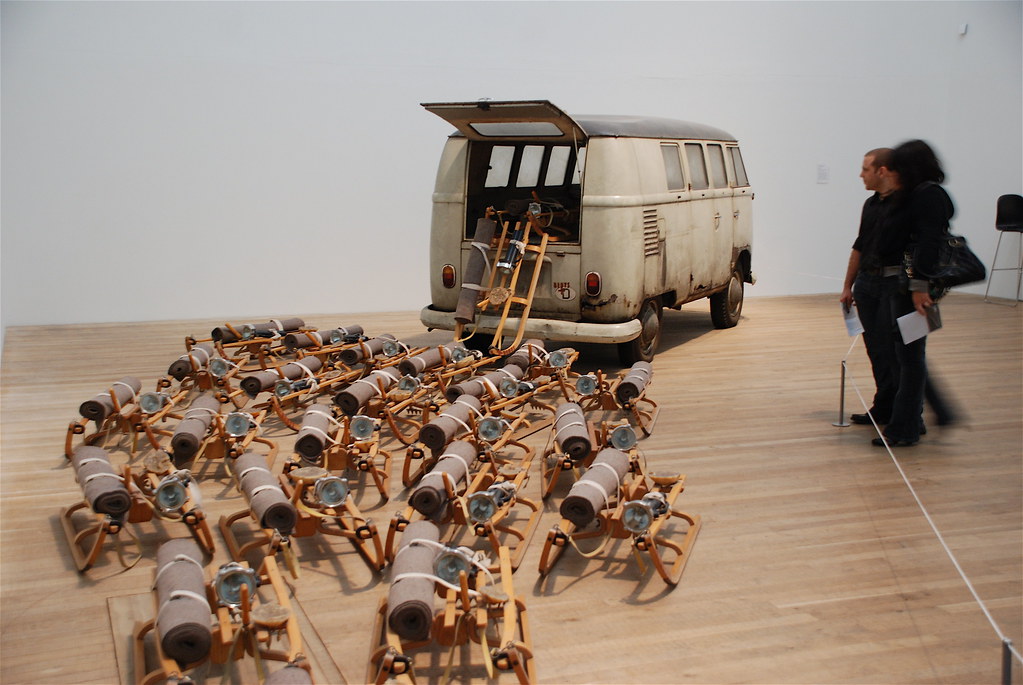
The Pack (1969)
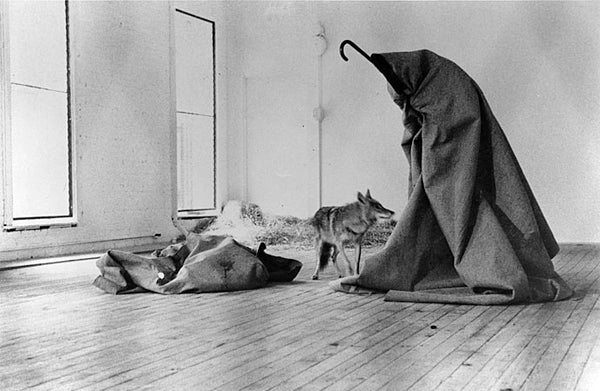
I Like America and America Likes Me (1974)


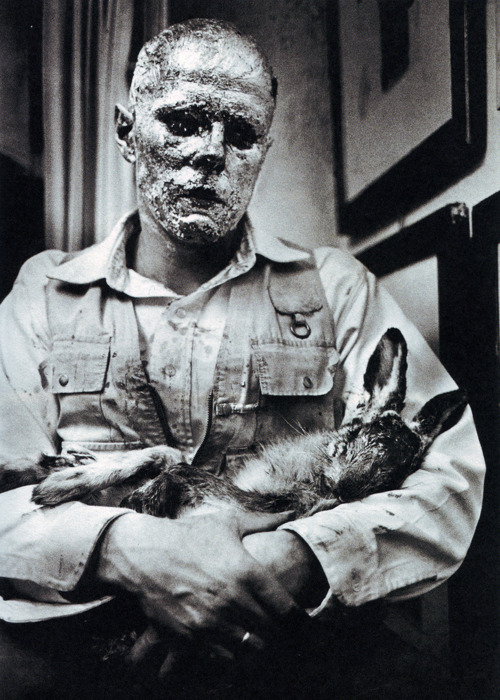
Beuys thought of society as a "giant social sculpture" and that everyone is an artist participating in the shaping of that sculpture. His works primarily deal with the interrelationships between humanity and nature on a physical and spiritual level. Probably the most well known work by Beuys is the performance piece, How to Explain Pictures to a Dead Hare. Beuys, with his head covered in honey and gold leaf, talked to a dead hare about pictures on the wall that he had drawn all the while keeping the audience locked out of the gallery for the duration of his discussion with the hare. All the materials used in the performance were symbolically powerful as well as practically important materials.

How to Explain Pictures to a Dead Hare (1965)
A few quotes by Beuys I came across that I found particularly intriguing are these:
"Environmental pollution advances parallel with the pollution of the world within us [...] It is no longer regarded as romantic but exceedingly realistic to fight for every tree, every plot of undeveloped land, every stream as yet un-poisoned, every old town centre and against every thoughtless reconstruction scheme."
"I believe that a human being is fundamentally a spiritual being, and that our vision of the world must be extended to encompass all the invisible energies with which we have lost contact or from which we have been alienated"

"If the theory behind the actual work (of art) were the actual work (of art), then I wouldn't have to make something which was to be perceived through the sense organs"

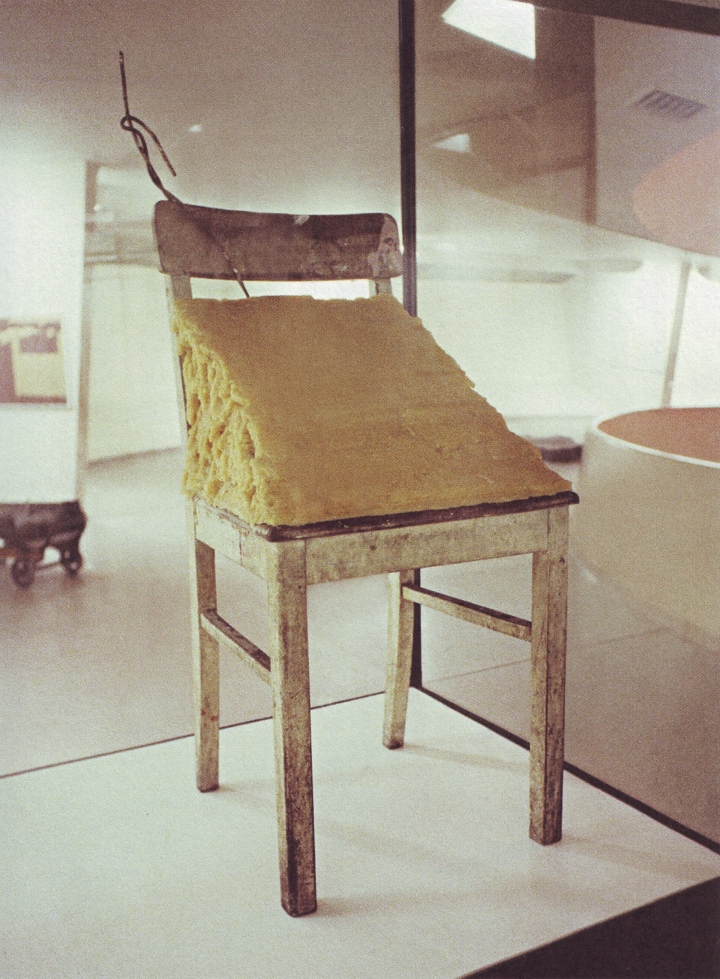
Fat Chair (1964-1985)
Fat Chair (1964-1985)
7000 Oaks: City Forestation instead of City Administration (1982-1987)
Trees from 7000 Oaks next to basalt pillars they were planted with

Sources: